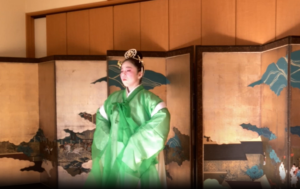
Shirabyoushi
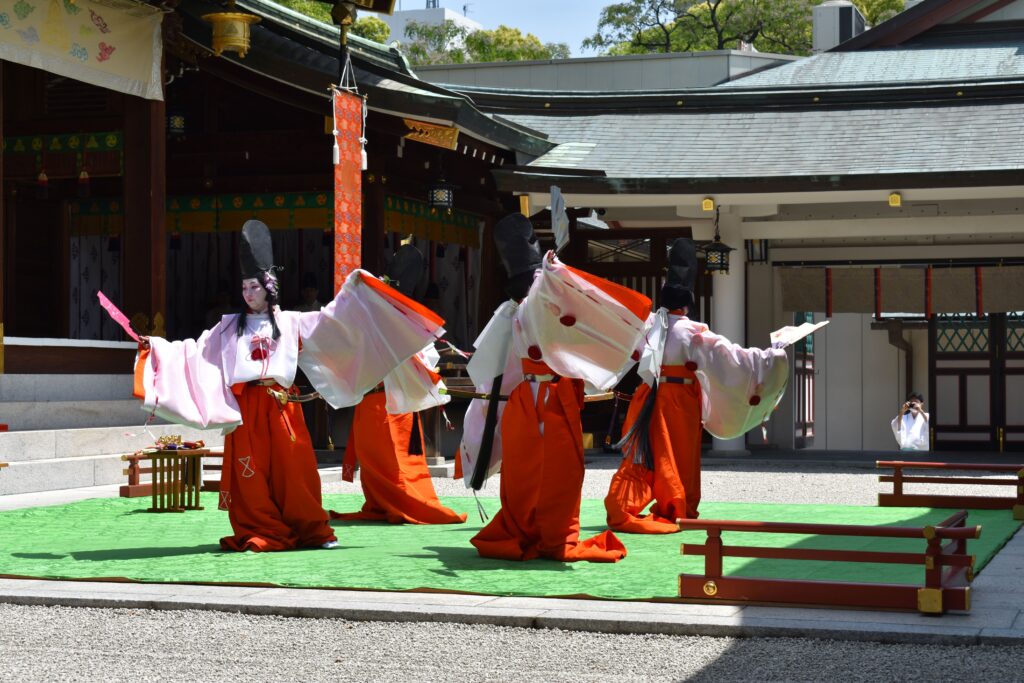
“Shirabyōshi” is a contemporary original bugaku dance created by the Harashōkai. It is choreographed to “Etenraku Imayō,” a version of the classical piece Etenraku in the Hyōjō mode to which lyrics were added.
The lyrics attributed to the monk Jien (Jichin Oshō) are especially well known:
In the dawn of Yayoi, the spring month,
When I gaze across the mountains in every direction,
Every peak seems in full bloom;
There is not a summit left untouched
By drifting white clouds.
The irises beneath the eaves are fragrant,
And the blossoming tachibana flowers give off their perfume.
In the lingering rains of early summer evening,
The mountain cuckoo
Calls out its name.
When the beginning of autumn arrives,
Half of the year has already passed.
As the moonlight that marks my waning years
Sinks toward the horizon,
I cannot help but feel a sense of pathos.
On a cold winter night at daybreak,
The mountain path on which we pledged our vows
Lies deep beneath the snow.
Though I cannot trace the footprints of the heart,
To think upon them from afar
Is moving indeed.
Shirabyōshi was a form of song and dance that flourished from the late Heian period through the Kamakura period. The term also refers to the performers themselves. In more casual terms, they might be described as the “cross-dressing idols of the late Heian era.”
The name generally refers to female entertainers (often courtesans) or children who performed dances while singing imayō songs or rōei chant-poetry, although there were also male shirabyōshi performers.
The Tale of the Heike, a military chronicle from the early Kamakura period in which several shirabyōshi appear, explains their origins as follows:
“During the reign of Emperor Toba, two women named Senzai of Shima and Waka no Mae began performing these dances. This marked the beginning of Shirabyōshi.”
It further explains:
“At first, the performers wore suikan robes, donned upright eboshi caps, and carried white-sheathed swords while dancing; for this reason the style was called otoko-mai (‘men’s dance’). Later, the eboshi and sword were discarded, leaving only the suikan robe, and the performance came to be known as Shirabyōshi.”
Follow me!