Itsukushima-Gojoraku
Goshōraku is one of the pieces in the gagaku repertoire and is classified as Tōgaku, the tradition of music of Chinese origin. It is traditionally attributed to Emperor Taizong of the Tang dynasty. The title, meaning “Music of the Five Virtues,” derives from the Confucian Five Constants—benevolence, righteousness, propriety, wisdom, and faithfulness—which are associated with the five musical tones: kyū (宮), shō (商), kaku (角), chi (徴), and u (羽).
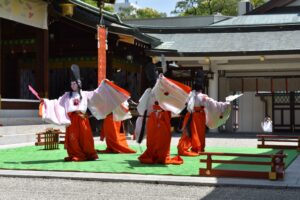
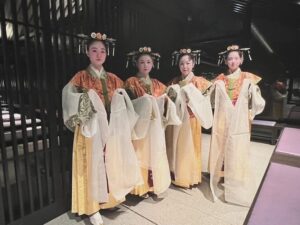
Today, Goshōraku is performed by male dancers wearing Ban’e costume. The Genshōkai, however, created a graceful interpretation performed by women.
The creator of this work and founder of the Genshōkai, Shōko Hara, was inspired by a passage in Volume Ten of the Ryōjin Hishō Kuden-shū:
“Two court ladies (naishi) of that land appeared, one in black and the other representing Śākyamuni. Dressed in Tang-style costume with their hair arranged up, they performed the dances Goshōraku and Komahoko.”
Upon reading this passage, Hara came to the realization that Goshōraku, now danced by men in Ban’e costume, had perhaps originally been performed by women. She quietly kept this insight in mind for many years.
In 2000, while preparing a performance based on the pilgrimage of Empress Kenshunmon-in to Itsukushima Shrine, she undertook a revival of Goshōraku as a women’s dance. Seeking to recreate a description praising the performance as “reminiscent of the graceful movements of the Bodhisattvas in Gigaku, whose sleeves must have waved in just such a manner,” she commissioned new nae costumes, a softer style of continental dress, in contrast to the bold and imposing Ban’e costume traditionally used for the dance.
Because no records remained concerning the original colors of the costumes, the search for historical references continued. Eventually, an illustration was found in the Ippen Shōnin Eden (The Illustrated Biography of the Monk Ippen). The image depicts four court ladies standing face to face on the floating stage of Itsukushima Shrine, dressed in blue and red nae costumes.
Using this illustration as the principal reference, Hara reconstructed the dance and revived it under the title “Itsukushima Goshōraku.”ired by the pilgrimage of Empress Kenshunmon-in to Itsukushima Shrine, Hara undertook an attempt to revive Goshōraku as a female dance. Inspired by a historical description that praised the performance as resembling “the graceful waving sleeves of the Bodhisattvas in Gigaku,” she sought to recreate its elegance on stage.
To distinguish the revival from the traditional male presentation in Ban’e costume, she commissioned new nae costumes, a softer style of continental dress appropriate for female dancers. Since no records of the original color scheme survived, she searched for visual references and eventually discovered an illustration in the Ippen Shōnin Eden (The Illustrated Biography of Ippen). The image depicts four court ladies standing face to face on the floating stage of Itsukushima Shrine, dressed in blue and red nae costumes.
Using this illustration as her primary source, Hara reconstructed the dance and presented it under the title “Itsukushima Goshōraku.”
Follow me!