Ryukaen
Ryūkaden is a piece in the gagaku repertoire that is said to have been brought to Japan by Kure no Sanemochi, a member of an imperial mission to Tang China during the Enryaku era (782–806). It is further said to have been rearranged from the Taishikichō mode into the Sōjō mode during the Jōwa era (834–848).
A Chinese poem by Sugawara no Michizane contains the line, “At the Early Spring Inner Banquet, I listened to the court ladies perform the melody Ryūkaen,” suggesting that female performers of the Imperial Music Bureau danced this piece at the New Year’s Inner Banquet. While the dance itself eventually disappeared, the music alone has survived.
Ryūkaen is also mentioned in The Tale of Genji, in the chapter “Hana no En” (“The Festival of the Cherry Blossoms”):
“Where is the Head Captain? He is late.”
At these words, he appeared and performed the dance called Ryūkaen. The timing was especially apt, as though he had anticipated just such a moment. The performance was so captivating that he was presented with a robe of honor, and people regarded it as a most extraordinary occasion.
Apart from this passage, however, references to the dance are rarely found in literary works or waka poetry from other periods.
Particularly noteworthy is the depiction of an Inner Banquet in the Nenjū Gyōji Emaki (Illustrated Scroll of Annual Court Ceremonies), which portrays the revival of the event in the late Heian period. The scene includes six female dancers, male musicians playing instruments such as the taiko drum, shō, hichiriki, and ryūteki flute, as well as women performing on the biwa, sō (koto), and hōkyō. The image offers a valuable glimpse into the participation of women in court musical culture.
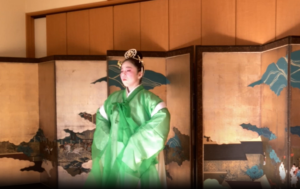
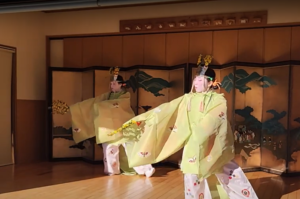
In the autumn of 1988, while preparing a program featuring several bugaku dances mentioned in The Tale of Genji, Shōko Hara was asked, “What exactly is the beautiful dance called Ryūkaen?” Inspired by this question, and marking the fiftieth year of her life devoted to bugaku, she resolved to revive the long-lost dance.
On April 8, 1989, drawing upon the dance figures depicted in Tang-style costume in the Shinsei Kogaku-zu, she created a reconstruction portraying court ladies who wore their hair dressed up, worked alongside men, and were accomplished in the art of poetry. Waving their long ceremonial scarves, they gather in a scene reminiscent of an ancient utagaki gathering, celebrating friendship and refinement through song and dance.
Follow me!